


 Fully integrated

Continia
Banking & Finance
replacing OPplus and Dynamo Pay Everything you need to know about the Transition
Banking &
replacing OPplus
The financial accounting add-ons OPplus and Dynamo Pay are being replaced by Continia Banking & Finance: These are two completely new add-ons for Business Central financial accounting. 💳 As a customer, you can already switch to the new modules, but you will need to adjust to new pricing structures.
Continia Banking & Continia Finance: Modular Structure ensures Continued High Flexibility
Continia Banking & Finance have been available since October 2024 and will gradually replace the Business Central add-on modules OPplus and Dynamo Pay. This article primarily compares the new modules with OPplus.
The new solutions have a modular structure - just like their predecessor, OPplus. This means you still have the option to select and combine exactly the features you need for the specific processes in your company. The modules include the features you already know from OPplus, as well as some new features. Continia Banking and Continia Finance can also be used separately from one another, but not in parallel with OPplus.
The New Financial Accounting Solutions for Business Central
Continia Banking
Continia Banking includes the core modules of OPplus: Payment Import and Payment Export. Direct Communications, which enables a direct connection between Business Central and individual banks, is also still available - now with direct integration within the module and without the need for a separate payment provider. For example, a bank can automatically transfer a bank statement to Business Central.
Moreover, automated intelligent processes enable the efficient allocation of incoming payments.
Integrated approval workflows and verification mechanisms also ensure that your payments are well protected against fraud and errors. For example, the security functionality can be used to verify bank accounts.
Continia Banking is currently available for both Business Central SaaS (Cloud) and on-premises.
Continia Finance
Continia Finance includes selected additional features from OPplus, thereby expanding the functionality of Dynamics 365 Business Central with valuable financial tools.
A key component, for example, is the G/L Open Entries feature, which allows you to manage G/L entries as open entries - such as customer or vendor ledger entries in the standard version of Business Central.
How does the Migration to Continia Banking & Finance work?
When migrating from OPplus to Continia Banking & Finance, some of your data can be transferred to the new modules. For other data, it is essential that a copy be backed up (for example, in a sandbox) prior to migration. This includes, among other things, the following data:
- Setup Data
- Import Journals
- Accounting Rules
- Imported Customer and Vendor Bank Accounts
- Reg. Payment Proposals
- Payment Posting Matrix
With regard to licenses, there are migration offers that provide financial benefits during the transition - similar to the promotional campaigns Bridge to the Cloud 2 (BTTC2) and Bridge to Cloud 3 (BTC3) for Business Central. However, this is highly individual, and what makes sense must be assessed on a case-by-case basis.
Typical Migration Process:
- Analysis of your existing banking processes in OPplus
- Setup and configuration of Continia Banking & Finance
- Import of relevant data (e.g., bank accounts, payment formats)
- Testing phase and fine-tuning of banking processes
- Go-live and brief training for users
Sales and Support: Timeline
Continia has published a timeline showing how long support for OPplus and Dynamo Pay will remain available. According to the timeline, support for OPplus will be completely discontinued in October 2027.
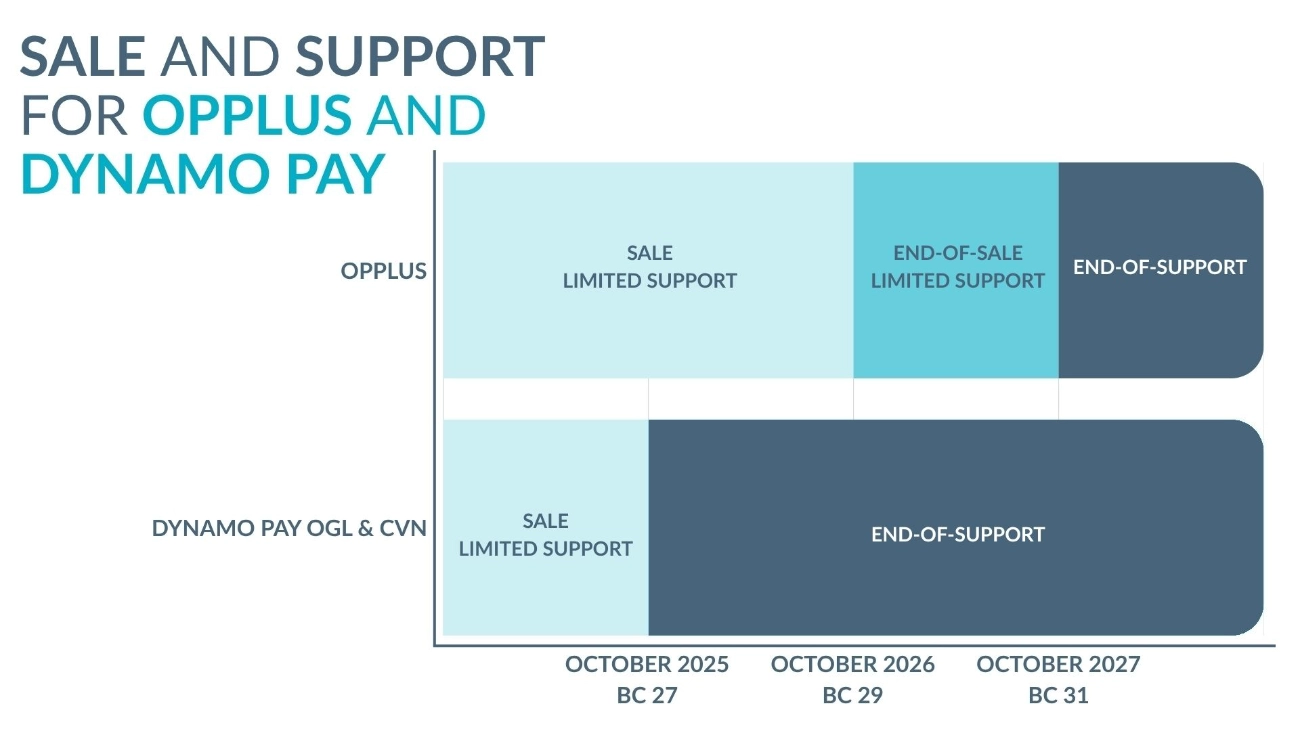
- Sale: You can license, activate, and use the solution as usual.
- End-of-Sale: Starting from the beginning of this period, you can no longer license the solution. Your existing maintenance contracts or cloud licenses remain active and will continue to be billed.
- Limited Support: Bug fixes and regulatory updates are provided for supported Business Central versions. No new features will be added. Starting at End-of-Sale, support will only include critical bug fixes and essential regulatory updates.
- End-of-Support: After Limited Support expires, there will be no further updates, bug fixes, or support services.
Costs and Licenses for Continia Banking & Finance
With OPplus, you could license modules on a per-user basis. If you had a large number of users, you also had the option to pay a fixed amount and then use as many users as you wanted (unlimited license).
Transaction-based Billing
Continia’s modules feature a new billing method: transaction-based billing. Licensing is based on the actual transactions performed by your company. This means you only pay for the usage that actually occurs. Each processed transaction - such as an incoming invoice, a digitized receipt, or a processed document set - is counted as a single unit.
Continia provides an additional module that calculates your company’s transaction volume, giving you an overview of the costs you can expect.
Please note: While transaction-based billing often works very well for companies with few but large business transactions (typically B2B businesses), it can quickly become expensive for B2C companies with thousands or millions of transactions.
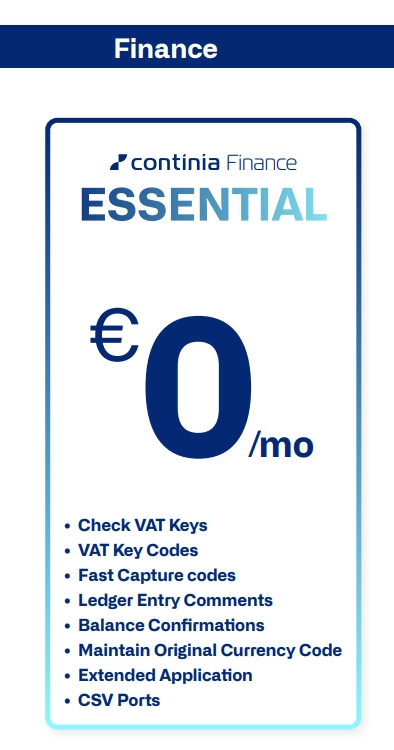
Free Essential Module
Continia Finance also offers an Essential module that you can use for free. It includes the following features:
Continia Banking & Finance Replaces OPplus and Dynamo Pay: Conclusion and Outlook
The transition from OPplus and Dynamo Pay to Continia’s two new solutions primarily involves a migration of the existing system landscape. Features such as integration with Business Central, the mapping of financial processes, and a user-friendly interface were already available in OPplus and will continue to be supported, albeit in a partially modified form.
Aspects such as direct communication with the bank and the secure design of payment processes are not fundamental innovations either, but were already part of the feature set of the predecessor, OPplus. With OPplus, however, a payment provider had to be used for this purpose. Potential efficiency gains therefore depend less on the modules themselves and more on the specific implementation and the respective business processes.
In one respect, however, the switch to the Continia modules improves the user experience: In OPplus, new fields were moved to separate pages. In the standard version, there was an “OPplus” action that took you to a page containing all OPplus fields and relevant standard fields. With the new Continia modules, however, the new fields can be found directly on the pages. This makes the work a bit easier.
At the same time, you should keep in mind that the switch to the new modules will likely involve higher costs for many companies. This applies in particular to companies in the B2C sector. With this in mind, it is advisable to carefully consider the timing of the switch. However, with support for OPplus ending in October 2027, the switch should be pursued, as there will no longer be any updates or bug fixes for the software after that date.
