


 The Enhancement Plan

Annual Maintenance
for Business Central
On-Premises What's changing Now and in the Future
for
As of April 2025, new customers have no longer been able to purchase new perpetual licenses for Business Central On-Premises. You can still continue to use perpetual licenses that were purchased earlier. Regular maintenance 🛠️ is also tied to existing on-premises perpetual licenses. What’s important to know about maintenance, how has the annual on-premises maintenance fee changed over the years, and how does maintenance for Business Central SaaS (Cloud) differ?
The Annual Maintenance Contract when purchasing a License
You could still purchase new Business Central perpetual licenses through the end of March 2025. When you purchased the licenses, you received the right to use the version of Business Central that was valid at the time of purchase. At the same time, this required you to “purchase” maintenance for a period of one year.
Optional Maintenance Renewal
Maintenance for Business Central On-Premises is governed by the Enhancement Plan (= maintenance contract). It is purchased for one year at a time and can be renewed annually thereafter. Renewing maintenance is generally not mandatory. However, it is a prerequisite to profit from certain rights and benefits.
Enhancement Plan: What does Maintenance cover?
In addition to the right to new versions/upgrades and updates, the Enhancement Plan specifically includes:
- Security updates
- Microsoft support services
- Certain license changes or expansion options
- Access to the latest product developments
Renew your Enhancement Plan and enjoy Long-Term Benefits
If you choose not to renew your Enhancement Plan, your system will remain at the last licensed version. It will be “frozen” and will not evolve further. This can lead to various disadvantages. In principle, it is possible to forgo maintenance. However, it is important for ensuring that your system operates sustainably, securely, and remains up to date with the latest technology.
Another key benefit of an active Enhancement Plan is that it can enable participation in attractive migration programs such as Bridge to Cloud 3. Continuously renewing your Enhancement Plan not only allows you to keep your existing on-premises system up to date, but also preserves your flexibility and cost-effective options for a future transition to the cloud.
Trends in On-Premises Maintenance Costs
Maintenance costs for Business Central On-Premises are calculated as a percentage of the respective license value. In recent years, this percentage has risen steadily. Since 2023, the maintenance fee has been increased by one percentage point each year:
- 2023 (effective October 1, 2022) → 17%
- 2024 (effective October 1, 2023) → 18%
- 2025 (effective October 1, 2024) → 19%
- 2026 (effective October 6, 2025) → 20%
- 2027 (effective October 1, 2026) → 21%
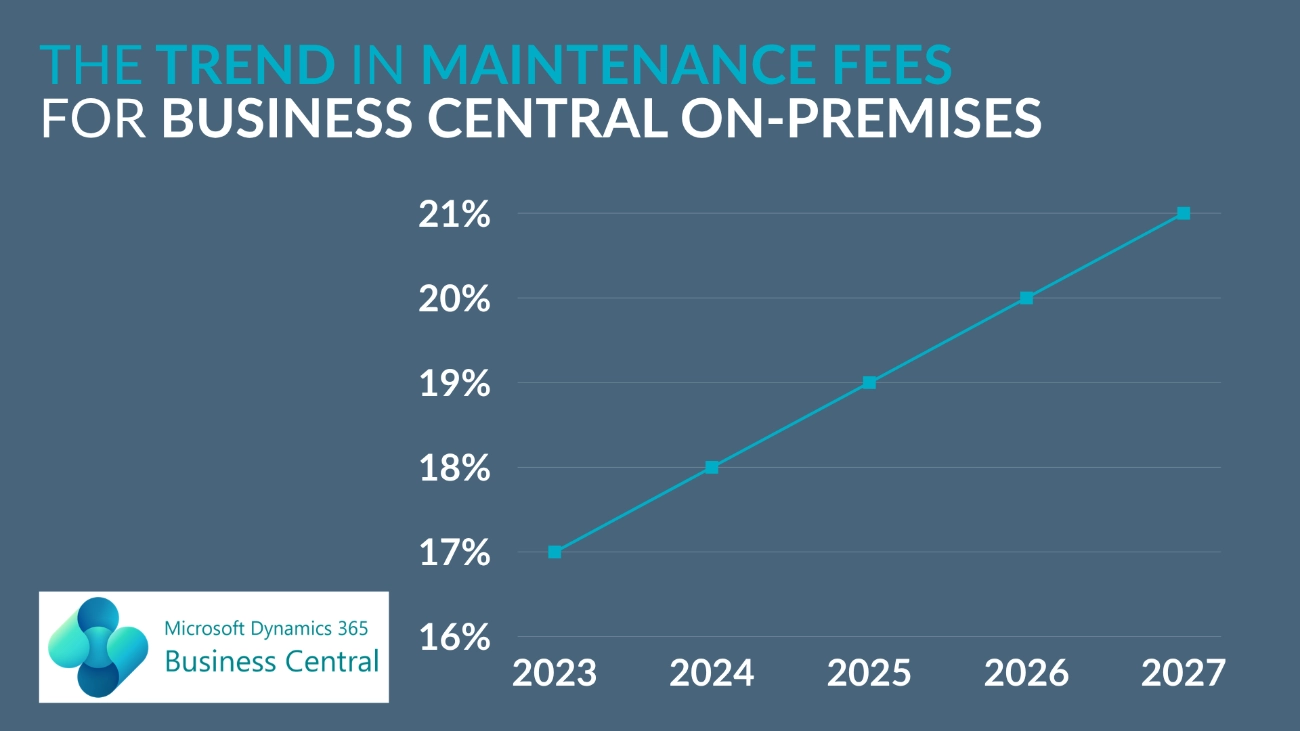
It is reasonable to assume that the maintenance fee could continue to rise in the coming years. As a result, operating Business Central On-Premises will become increasingly costly in the long term. When deciding whether or not to switch to the subscription model, you should therefore consider not only the one-time license costs but also the long-term trend in ongoing maintenance costs.
Differences from the Subscription Model (Cloud)
With the cloud-based subscription model, you don’t have to actively worry about maintaining or updating your system at all. Updates and new features are regularly provided by Microsoft and automatically applied to your Business Central environment. The costs for this are also already included in the license.
System updates are thus an integral part of the subscription model. Separate maintenance contracts or a separate decision to renew maintenance are therefore not required.
For you, this means that your Business Central environment remains continuously up to date and consistently benefits from new features, technical enhancements, and security updates. The costs associated with this are already covered by the ongoing license fees.
Effective April 2025: Perpetual Licenses Available Only to Existing Customers
Microsoft has fundamentally changed the on-premises licensing model for new customers: As of April 1, 2025, new customers can no longer purchase Business Central On-Premises as a traditional perpetual license. For them, the on-premises version has since been available only as a subscription model.

The Era of Business Central Perpetual Licenses is over Why switching
to the Cloud makes
More Sense than ever -
and how to do it Smoothly
to
More Sense
and
Outlook: Major Changes to the On-Premises Model starting in 2027 and 2031
This makes it clear in which direction Microsoft’s licensing strategy is heading: The traditional on-premises model is being phased out, while the focus is increasingly shifting to the cloud.
Valid through December 31, 2027: “Bridge to Cloud 3” Promotion
With the “Bridge to Cloud 3” promotion, Microsoft is helping its existing on-premises customers make a phased transition to the cloud. Starting from the date you purchase the promotion, you’ll benefit from attractive terms for a period of three years and can gradually build out your new cloud environment during this time.
At the same time, you can continue to use your existing on-premises environment. This means you don’t have to make the switch all at once; instead, you can plan and implement the migration over a longer period of time.
This gives you additional flexibility: You can adapt your processes and applications to the cloud step by step, gain experience with the new environment, and prepare for the transition in a targeted manner. This makes the switch to Business Central SaaS less stressful and involves lower transition risks.
More information about the promotion:

Special Promotion for Companies planning to migrate to the Cloud Save 30%
on your Business
Central Subscriptions
with Bridge to Cloud 3
on
Central
with Bridge
What’s Next for You?
Developments surrounding Business Central On-Premises clearly show that Microsoft’s focus is shifting further and further toward the cloud. At the same time, companies with existing on-premises licenses have various options, so a transition doesn’t necessarily have to happen right away.
Which solution is right for you depends on your individual situation, your existing licenses, your requirements, and your long-term strategy.
We’d be happy to work with you to review your current situation and discuss what options are available to you and what the next steps should be.

More information
on the topic Maintenance
on the