


 Project Management

The Devil's 😈
Triangle of an ERP Project Why Fast, Affordable, and High-quality can't all be achieved at the Same Time
Triangle
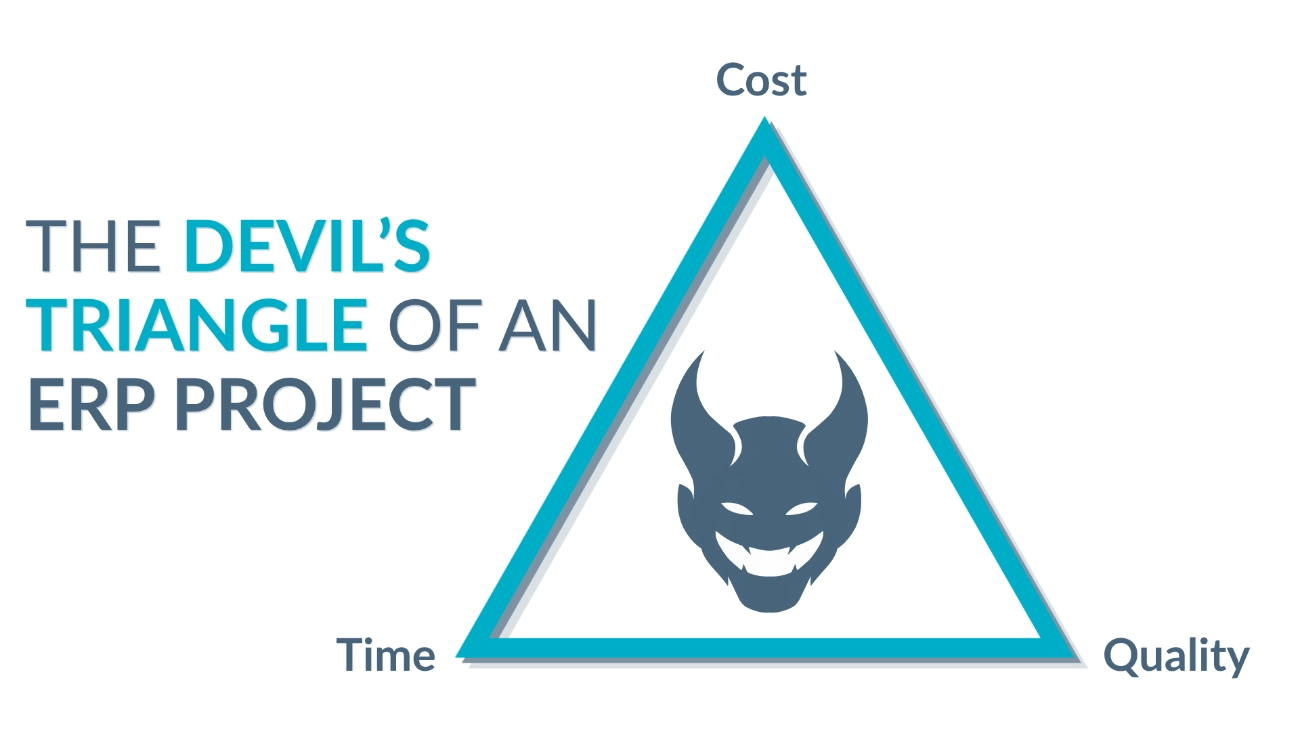
Of course, every company wants the ERP solution it has chosen to be delivered, implemented, and supported with high quality as well as quickly and affordably. However, in a project, you can achieve at most two of these three goals at the same time. This is referred to as the “devil’s 😈 triangle.” What is the best way to resolve this conflict of objectives?
Fast, Affordable, and High-quality: The Classic Trade-off in ERP Projects
Companies looking to implement a new ERP solution typically have three clear requirements:
- The software should be high-quality and state-of-the-art
- It should be implemented as quickly as possible
- And it shouldn’t be too expensive
That sounds logical and reasonable. But in practice, this is where one of the biggest challenges of modern ERP projects arises. Because this is precisely where the famous conflict of objectives in project management comes into play: the so-called “devil’s triangle.” 😈
The Devil’s Triangle of an ERP Project
The devil’s triangle describes the three key factors of a project:
- Time
- Cost
- Quality
However, in a project, it is generally only possible to optimally achieve two of these three goals at the same time. The third factor always ends up suffering as a result. Therefore, compromises must be made.
| Focus | Possible Consequence |
|---|---|
| Fast + Low Cost | Quality suffers |
| Fast + High Quality | Costs rise |
| Low Cost + High Quality | Project takes longer |
The Three Factors in Detail
In practice, time, cost, and quality are closely intertwined and influence one another in every project phase. To better understand these relationships, we will examine each of the three factors individually and in detail below.
Time
Today, modern, cloud-based ERP systems can be deployed much more quickly than on-premises solutions. The real work therefore usually begins only after the software has been installed. This is because an ERP system not only changes your IT landscape but also has a profound impact on your company’s workflows, responsibilities, and decision-making processes. It often becomes clear only as the project progresses that individual departments, for example, have established completely different processes for the same task.
ERP systems such as Dynamics 365 Business Central from Microsoft can simplify or automate many tasks. Nevertheless, those responsible must contribute their own understanding of the processes and continue to make organizational decisions as well as take charge of change management.
When it comes to the time factor, many poor decisions are made in ERP projects. The desire for a quick implementation often arises when necessary decisions are postponed or unresolved process conflicts are swept under the rug. This almost always comes back to haunt the project as it progresses. Unresolved issues do not disappear; they are merely pushed into later project phases. And then changes become significantly more expensive, riskier, and time-sensitive. If you truly want to shorten the project duration, you should make important decisions as early and consistently as possible.
Cost
Of course, no one wants to pay more than necessary for an ERP project. However, problems arise when you consider costs solely from a short-term perspective. Keep in mind that the cheapest solution is rarely the most cost-effective! Especially with ERP implementations, the highest costs often stem not from the software itself, but from poor decisions made during the project, inadequate preparation, or a lack of buy-in within the company.
Many companies therefore cut corners in the wrong places. For example, they choose solutions or implementation partners that offer little continuity. They also allocate too little time for project preparation or underestimate the effort required for organizational changes. Furthermore, unsuitable key users are sometimes selected, or internal communication remains too superficial or takes place too late. In the short term, this may reduce your project costs, but in the long term, risks, additional effort, and follow-up costs increase significantly.
Costs in ERP projects should therefore not be considered in isolation. They are always directly interrelated with time and quality. If you focus exclusively on low project costs, you will usually pay for it later with longer project durations or poorer results.

ERP Selection: Protect yourself from
a Discount-related Amnesia!
a
Quality
In practice, the quality of solutions and decisions is unfortunately often subordinated to the desire for lower costs or shorter project timelines. This is where one of the greatest risks arises. Poor decisions in ERP projects are rarely immediately apparent. Their negative effects often only become evident months later in day-to-day operations.
In the context of an ERP project, quality does not mean that every one of your requirements must be implemented as a custom feature or that processes should be mapped as complexly as possible. On the contrary: Good ERP solutions often benefit from simplification, standardization, and clear responsibilities. At the end of the day, what matters is that your processes function in a way that is stable, understandable, and scalable in the long term.
That is why you should consciously prioritize quality in your ERP project. This applies both to the selection of the ERP solution and to decisions made during implementation. This also includes ensuring sufficient capacity within the company and, as far as possible, avoiding the simultaneous launch of other internal projects. After all, ERP implementations often fail due to a lack of focus.
Choosing the right solution deserves special attention. It is crucial that you use the right selection criteria. It is not enough to simply consider licensing costs or features.
We recommend Dynamics 365 Business Central. Microsoft is consistently developing the solution for small and medium-sized businesses, placing particular emphasis on usability, standardization, and easy onboarding.
The Devil’s Triangle of Your ERP Project: Make Informed Decisions!
All in all, the devil’s triangle dilemma cannot be completely resolved. It is an area of tension that must be actively managed. However, it is only possible to achieve two of the three goals equally. The crucial question is therefore not “How do we get everything at once?” but “Which priorities are truly critical for our company?”
In our experience, quality should always come first. Poor processes, unclear responsibilities, or hasty decisions almost always result in higher costs and greater delays in the long run than a clean implementation. Errors in ERP projects do not simply disappear on their own. They are merely deferred to later operations. And that makes the whole process significantly more expensive, complex, and difficult to correct.
This does not mean that time and cost are unimportant for your project. On the contrary: you should plan both factors realistically and manage them consistently. However, if you try to implement the project as quickly and as cheaply as possible while still maintaining high quality, the project risk increases significantly.
It is just as important that the goals of your project are understood throughout the entire company. Not only the project management and IT teams, but all employees involved in the project must know and understand the overall goals of the ERP project. Only when everyone involved pulls together can new processes be successfully established and permanently embedded in the company. After all, an ERP project is never just an IT project - it is always an organizational project as well.
