

 Making Data-driven Decisions

Microsoft Fabric End-to-end Data Analysis
with Power BI and Co.
with
Microsoft Fabric is a centralized, cloud-based data platform that helps you efficiently collect, manage, and analyze your data. By bundling multiple analytics and data tools into a single environment, it reduces technical complexity and IT overhead. This makes it easier for you to make data-driven decisions and optimize business processes in a targeted manner.
Microsoft Fabric: The All-in-one Solution for Modern Data Management
Microsoft Fabric combines multiple Microsoft services into a single, user-friendly solution that is easily accessible to all team members. Centralized management allows you to access your data faster and make more informed decisions.
The advantage of Fabric is that you no longer need to use multiple isolated tools, but can run everything through a unified user interface and infrastructure.
Capabilities of Microsoft Fabric
- Data integration and preparation: Fabric combines data from various sources, prepares it, and enables data pipelines.
- Data lake and data warehouse: Fabric provides a central storage location for large amounts of data. Both structured data (e.g., from databases) and unstructured data (e.g., files or logs) can be securely stored, organized, and used for analysis.
- Data modeling and analysis: The platform enables users to analyze data, create models, and gain deeper insights.
- Visualization and reporting: This is where Power BI comes into play as the central tool for visualization and reporting within Microsoft Fabric.
- Machine learning and AI: Integrated machine learning tools enable data-driven decisions and the development of helpful models.
- Role-specific workloads: Microsoft Fabric offers specially customized workspaces and tools for different roles - for example, for data engineers, data scientists, and business analysts. This allows each user group to work with the functions relevant to them without unnecessary complexity.
Components of Microsoft Fabric
OneLake
OneLake is Microsoft Fabric’s central data storage concept and forms the foundation of the entire platform. It acts as “OneDrive for data” and provides a unified, cross-tenant data lake. It collects all types of data in one place so that teams can use the same up-to-date information - without copies or detours. This saves storage space, avoids data chaos, and allows you to work faster and more efficiently.
Power BI
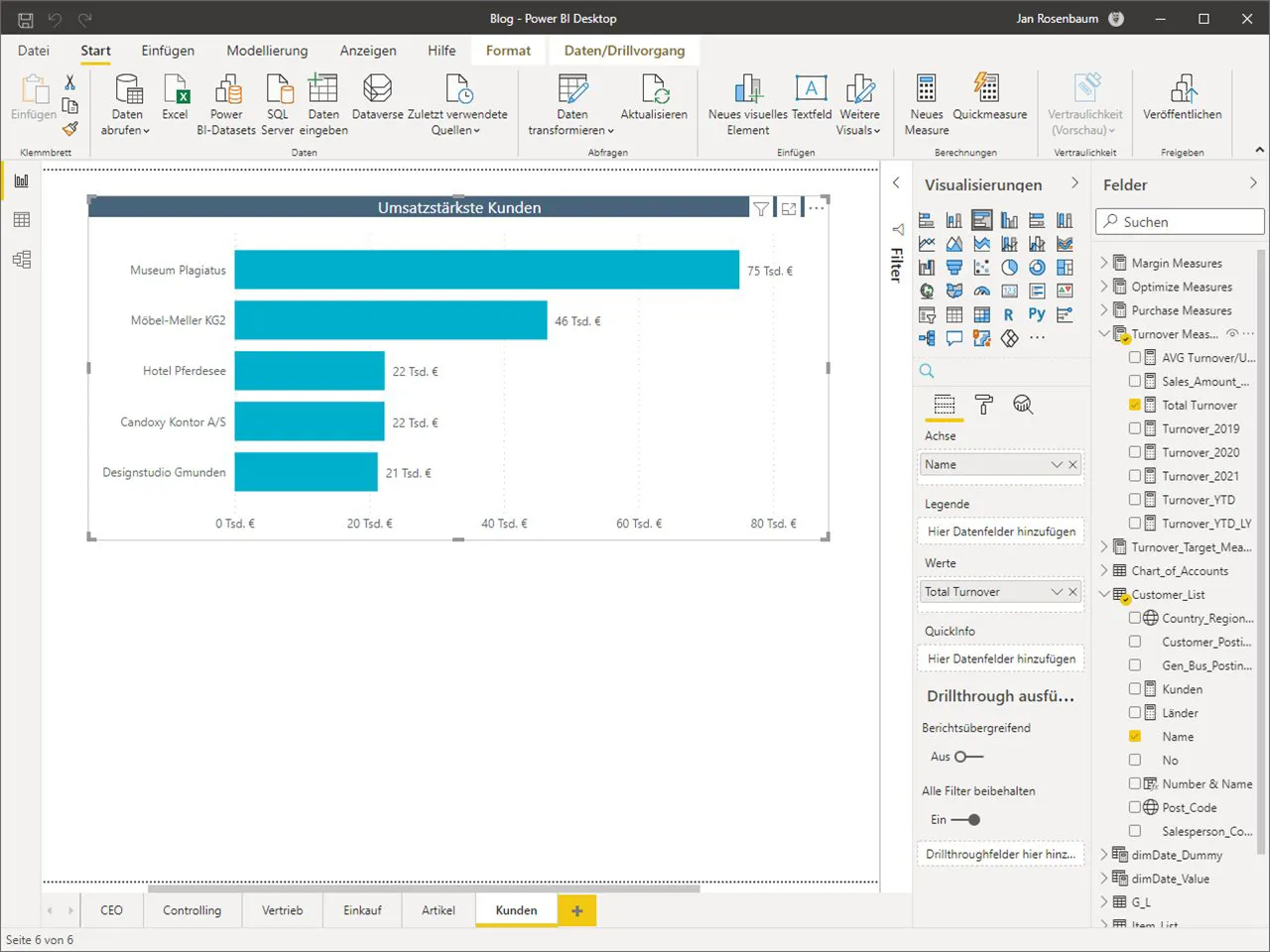
Power BI is the central analysis and visualization component of Microsoft Fabric. It enables users to create interactive reports and dashboards for making data-driven decisions. Thanks to native integration with Fabric, reports can access data directly from OneLake without the need for additional data copies or complex interfaces.
Both business users and data experts benefit from self-service analytics, real-time dashboards, and seamless collaboration within the organization.
Power BI Basics Get started
with your Data
Analysis in just 5 Steps
Analysis in
Data Factory
Data Factory in Microsoft Fabric is used for data integration and orchestration. It enables the extraction, transformation, and loading (ETL/ELT) of data from a wide variety of sources, such as databases, cloud services, or on-premises systems.
Thanks to a graphical user interface and ready-made connectors, data pipelines can be quickly created, automated, and monitored. No in-depth programming knowledge is required.
Analytics
Fabric Data Engineering
Fabric Data Engineering enables large amounts of data to be processed and transformed efficiently. Data can be cleaned, enriched, and prepared for analytical purposes.
This component is particularly aimed at data engineers who need scalable data processing processes and benefit from close integration with OneLake and other Fabric services.
Fabric Data Science
The data science component of Microsoft Fabric supports advanced analytics and machine learning scenarios. Data scientists can develop, train, and deploy models - for example, for forecasting, classification, or anomaly detection.
Thanks to integrated notebooks and the connection to Azure Machine Learning, experiments can be carried out efficiently and results shared directly with other Fabric components.
Fabric Data Warehouse
Fabric Data Warehouse is a modern, powerful data warehouse solution within Microsoft Fabric. It enables fast SQL-based analyses based on large amounts of data and is suitable for both classic BI scenarios and ad hoc queries.
The shared database in OneLake eliminates the need for redundant data storage. This increases performance and reduces costs.
Databases
Databases in Microsoft Fabric are classic SQL databases for operational/transactional data.
Real-Time Intelligence
The Real-Time Intelligence component is designed for rapid analysis of data that is continuously generated, such as events, logs, or sensor data. It enables queries with very low latency and is particularly suitable for monitoring, live analysis, and detecting anomalies in near real time. The focus is on making visible what is currently happening in systems or processes.
IQ (currently still a Preview Feature)
Fabric IQ is a newly introduced workload within Microsoft Fabric that provides a comprehensive semantic layer based on the data stored in OneLake. The aim is to map business entities, their relationships, and company-specific logic in a structured way. This creates a common language for humans and AI agents.
Please note: This feature is currently only available to you in a preview version.

Advantages of Microsoft Fabric
-
Unified platform
Bundles Power BI, Data Factory, and ML tools in OneLake - minimizes complexity and silos for all roles -
Cost savings
Avoids redundant storage, leverages shared capacity (CUs), and pay-per-use -
Fast analytics
Real-time access, self-service BI, and direct SQL/ML without copies for rapid decision-making -
Role-specific workloads
Tailored tools for data engineers, data scientists, and analysts
Microsoft Fabric: A New Level of Data Analysis
Microsoft Fabric helps your company manage its data in a single, secure, and flexible platform. With integrated tools for analysis, collaboration, and machine learning, you can take your data to a new level and make even more informed decisions - faster and more efficiently than ever before.